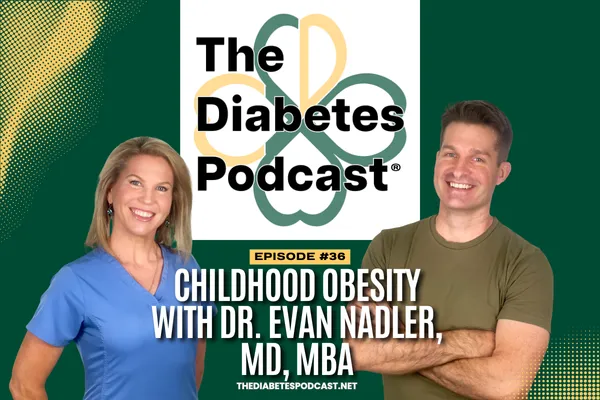
EP036: Childhood Obesity with Dr Evan Nadler
Childhood Obesity Levels: A Compassionate, Science-Backed Guide with Dr. Evan Nadler, MD, MBA
“Epigenetics isn’t an on/off switch—it’s a dimmer. Environment slides the control.”
Welcome to The Diabetes Podcast blog. In this post, we’re sharing a powerful conversation with Dr. Evan P. Nadler, MD, MBA. He is a pioneer in childhood obesity care, a leading pediatric bariatric surgeon, and the host of Obesity Explained. He has helped children and families for more than 20 years. He also leads research, teaches, and is writing a new book called “The Skinny on Childhood Obesity.”
This is a big topic. But you don’t need shame. You need clear, simple steps. That’s what Dr. Nadler brings: science-backed help that real families can use.
First, words matter: people-first language
Don’t say “obese child.” Say “a child with obesity.”
Don’t say “diabetic.” Say “a person with diabetes.”
This shows respect. It reduces stigma. It helps kids feel seen and safe.
How childhood obesity levels changed
Years ago, people said “juvenile” diabetes and “adult-onset” diabetes.
Today we say type 1 (autoimmune), type 2 (insulin resistance), and even mixed types.
Why the change? Because more kids now have type 2. Age isn’t the key. Biology is.
In the U.S., about 15 million children are living with obesity. That is a lot of kids and a lot of families who need care.
Why two teens at the same weight can be so different
Obesity is not only about diet and exercise. Biology matters.
Genetics can explain 40–70% of obesity risk. That risk may even be higher when we include epigenetics.
Epigenetics means the environment can “turn the dimmer” on how genes work. It’s not an on/off switch. It’s a slider.
Two teens can have the same BMI but very different health risks because their biology is different.
Monogenic vs. polygenic obesity
In the past, more children with obesity had single-gene or syndromic causes (like Prader-Willi or Bardet–Biedl). Those rates have not exploded.
Today, most cases are polygenic: many genes plus environment and epigenetics.
Bottom line: biology and environment interact. It’s not simple, and it’s not anyone’s fault.
Small for age, big risk: the early life story
Babies who are small for gestational age, or who had poor nutrition in the womb, may later have higher obesity risk.
Their bodies got very good at storing energy. In today’s high-calorie world, those “store, store, store” signals can work against health.
This shows why caring for parents’ health before and during pregnancy matters.
A kinder way to help at home: your “in-home biodome”
You can’t control the whole world. But you can shape your home to make healthy choices easier. Think of your home as a safe “biodome.”
Start here:
Drinks: Make water and sparkling water the default. Remove sugar-sweetened drinks (soda, juice drinks, sweet teas). Avoid “diet” drinks with artificial sweeteners if you can.
Snacks: Stock minimally processed foods first. Examples: fruit, veggies with dip, nuts (if safe), yogurt, cheese, hard-boiled eggs, whole-grain crackers, popcorn, and higher-protein crunchy swaps.
Meals: Aim for protein + fiber at each meal. Keep it simple and affordable. Frozen veggies, canned beans, eggs, and rotisserie chicken can help.
Visibility: Put healthy options at eye level. Hide treat foods or buy them less often.
Routines: Plan a snack spot and snack times. Predictable beats “anything, anytime.”
Screens and sleep: Try for consistent bedtimes and screen limits in the evening. Sleep impacts hunger signals and insulin.
Family first, not child alone
Family participation is key. If a child must change but everyone else eats and drinks the old way, it is harder and feels unfair.
Parents: if you need a soda, have it away from home. Don’t keep it in the house for a season while your child is working on change.
Keep the tone positive. This is not punishment. It’s care.
What moves the needle most
Removing sugar-sweetened beverages from the home is one of the biggest wins.
Pair small lifestyle changes with medical care when needed. Diet and exercise alone are usually not enough once the disease is established.
Some teens may benefit from medicines (for example, GLP-1s) or, in severe cases, bariatric surgery. These are evidence-based tools used with expert care.
Nothing works for everyone. That’s okay. Biology differs. Keep judgment out and hope in.
How pediatricians and clinicians can help today
Use people-first language.
Use growth charts and EHR alerts to identify risk and discuss it early, with empathy.
Refer interested families to pediatric obesity specialists when possible.
Learn evidence-based pediatric obesity treatments. Over time, primary care will need to manage much of this care to reach all children who need help.
School, community, and policy: many small dents make progress
PE in schools helps, but it’s only one piece. To make a real dent, pair movement with better school meals and safe spaces to play.
Improve access: more grocery stores in food deserts, safer sidewalks and parks, and affordable healthy foods.
SNAP and WIC policy should limit harmful options and also make healthy choices easy and available. If we remove access to one thing, we should provide better options at the same time.
Why this is hopeful
We haven’t truly tried, at scale, for kids yet. That means there is huge room for improvement.
Young adults can make a big impact before pregnancy by improving their own metabolic health and habits.
Families can build an in-home biodome one small step at a time.
With science-backed care, compassion, and access, we can change childhood obesity levels for the next generation.
Where to learn more from Dr. Nadler
Website: Obesity Explained | Evan P. Nadler MD, MBA
YouTube: @ObesityExplained (science made simple, practical steps)
Clinical care: ProCare TeleHealth is a virtual pediatric and family weight management clinic that offers evidence-based care nationwide.
Book: The Skinny on Childhood Obesity (upcoming)
Newsletter: The Children’s Health Reframe (science-backed, practical guidance)
Key takeaways for families
Use people-first language and lead with kindness.
Start with drinks: water first; remove sugary beverages.
Make your home a safe zone with simple, affordable swaps.
Ask your pediatrician about evidence-based treatments, including medicines and, when needed, surgery.
Don’t compare your child to others. Biology is different for everyone.
Small steps count. Keep going.
If you’re ready for expert, virtual support, explore ProCare TeleHealth for comprehensive, compassionate care for children, teens, and families. And for clear, science-backed education, start watching Obesity Explained today.
As always, if you need additional help or have questions, reach out to us at [email protected].
Until next time, take courage. You can do this, and we can help.
Disclaimer
The information in this blog post and podcast is for educational and informational purposes only. It is not medical advice, diagnosis, or treatment, and it does not replace a one-on-one relationship with your physician or qualified healthcare professional. Always talk with your doctor, pharmacist, or care team before starting, stopping, or changing any medication, supplement, exercise plan, or nutrition plan—especially if you have diabetes, prediabetes, heart, liver, or kidney conditions, or take prescription drugs like metformin or insulin.
Results vary from person to person. Examples, statistics, or studies are shared to educate, not to promise outcomes. Any discussion of medications, dosing, or side effects is general in nature and may not be appropriate for your specific situation. Do not ignore professional medical advice or delay seeking it because of something you read or heard here. If you think you are experiencing an emergency or severe side effects (such as persistent vomiting, severe diarrhea, signs of dehydration, allergic reaction, or symptoms of lactic acidosis), call your local emergency number or seek urgent care right away.
We strive for accuracy, but health information changes over time. We make no guarantees regarding completeness, timeliness, or suitability of the content and assume no liability for actions taken or not taken based on this material. Use of this content is at your own risk.
Links or references to third-party resources are provided for convenience and do not constitute endorsement. By reading, listening, or using this information, you agree to these terms and understand that you are responsible for your own health decisions in partnership with your licensed healthcare provider.


